If you’ve reached the point of searching “full mouth dental implants,” there’s a good chance you already know you’re facing the loss of most or all of your teeth, and you’re trying to work out what actually happens next. This isn’t a single fixed treatment. It’s a decision between a few genuinely different paths, each with its own trade-offs in stability, maintenance and how the day-to-day experience compares to natural teeth. This piece is the starting point: what the options are, what the process generally looks like, and what affects the cost, so you’ve got a clear enough picture to know which option to look into further.
Quick overview
- What it means: replacing most or all of the teeth in one or both jaws, usually with a combination of dental implants and a fixed or removable restoration
- Your main options: a fixed implant-supported full arch (often called All-on-X), a removable implant-supported overdenture, or a conventional denture with no implants at all
- What it depends on: jawbone volume and density, how many teeth are already missing, overall health, and personal preference around fixed versus removable
- What to do: book a consultation and 3D imaging to see which option actually applies to your bone and bite, since none of this can be judged accurately without an assessment
When might you need full mouth dental implants?
Most people don’t arrive here because of a single missing tooth. It’s usually a build-up: several teeth lost or failing over the years, long-term denture wearers whose jawbone has reduced to the point where the denture no longer fits well, or advanced gum disease that’s loosened multiple teeth beyond saving. Healthdirect lists gum disease, along with risk factors like smoking and diabetes, as relevant to implant candidacy generally, and the same factors are often what drove the tooth loss in the first place. If you’re only dealing with one or two missing teeth, the options are broader and simpler than what’s covered here, our guide to fixing missing teeth covers that more general situation. This piece is specifically for when most or all of the teeth in an arch are involved.
Your three broad options
A fixed implant-supported full arch:
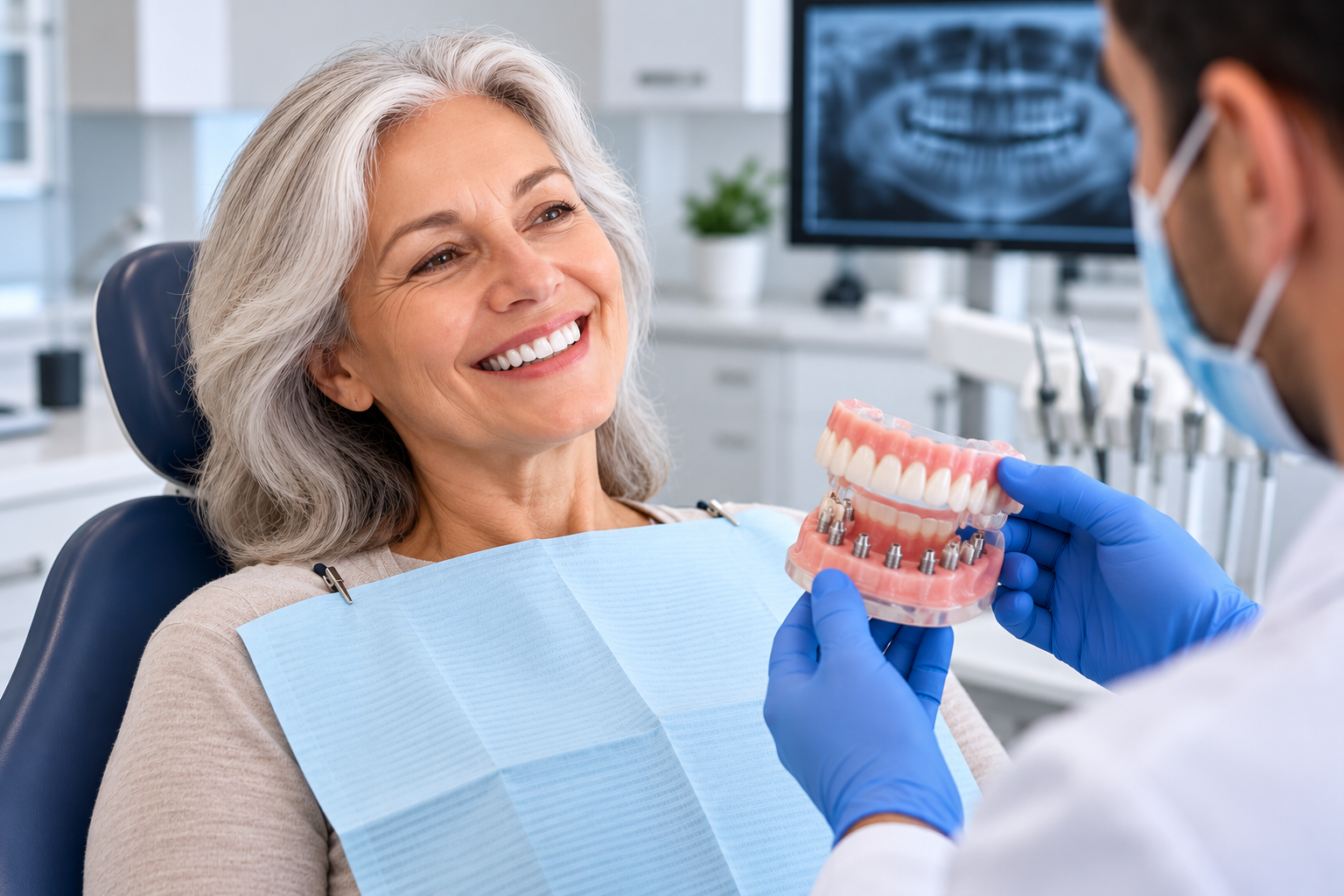
Often described as All-on-X, replaces an entire arch of teeth with a non-removable bridge anchored to implants. Cleveland Clinic describes four to six implants as the usual number needed to support a full arch, though the exact count depends on individual bone volume and bite force. This is the option closest to having a full set of natural, fixed teeth again. Our All-on-X guide goes through how that implant number is actually decided, and the full arch replacement page covers the treatment in more detail.
A removable implant-supported overdenture:
It uses fewer implants, often as few as two to four, to anchor a denture that clips in and out for cleaning. It’s considerably more stable than a conventional denture, since the implants stop it slipping, but it’s still removed at night and for cleaning, unlike a fixed full arch. It tends to suit people who want more stability than a conventional denture without the cost or surgical scope of a full fixed arch. The implant-supported dentures page explains how this compares to both a fixed arch and a conventional denture in more depth.
A conventional complete denture
A conventional denture with no implants at all, remains an option too. It’s the lowest upfront commitment and involves no surgery, but it’s also the least stable of the three, and over time, jawbone that isn’t being stimulated by a tooth root or implant tends to shrink, which is part of why dentures often need relining or replacing over the years.
None of these is automatically the “best” option. What suits one person’s bone volume, budget timeline and lifestyle won’t suit another’s, which is exactly why an in-person assessment matters more than anything written here.
What the treatment process generally involves
The process starts with a consultation and imaging, usually a 3D scan, to assess jawbone volume and density, check for any gum disease that needs treating first, and confirm overall suitability. If there isn’t enough bone to support implants securely, Cleveland Clinic notes that bone grafting may be recommended to build it up before implants can be placed. Our bone grafting page covers that step in more detail for anyone it applies to.
Once the plan is set, any remaining teeth that can’t be saved are extracted, and the implants are placed under local anaesthetic, sometimes alongside sedation depending on the scope of the case. The site is then given time to heal. Healthdirect describes this healing process, known as osseointegration, as taking around three months for the bone to fuse to the implant, while Cleveland Clinic gives a wider range of three to nine months depending on individual healing. Some patients are suitable for temporary fixed teeth on the day of surgery; others wear a temporary restoration while healing completes. Once osseointegration is confirmed, the final restoration, whether that’s a fixed bridge or a denture that clips onto the implants, is fitted.
What affects how much it costs
Cost varies case by case, and there isn’t a single number that applies across the board, but a few things consistently drive it. The number of implants placed is the biggest factor, a fixed full arch using four to six implants costs more than a removable overdenture using two to four. Bone grafting, where it’s needed, adds to the process and the cost. The materials used for the final restoration, and whether sedation is involved beyond local anaesthetic, also play a part. The most accurate way to understand cost for your specific situation is a consultation, since it depends entirely on what your bone, bite and existing teeth actually require.
How long do full mouth dental implants last?
With proper care, Cleveland Clinic notes that dental implants themselves can often last for many years, since the implant fuses directly into the jawbone. The restoration attached to them, the crown, bridge or denture, has a shorter lifespan and may need replacing over time, crowns and bridges are commonly cited around the 15-year mark, while conventional dentures are generally replaced or relined from around 7 years onward as the jawbone and gums change shape. Regular check-ups matter regardless of which option is chosen, since they are what catch wear or fit issues early.
Comparing your options for full mouth teeth replacement
| Fixed full arch (All-on-X) | Implant-supported overdenture | Conventional denture | |
|---|---|---|---|
| Removable | No | Yes, for cleaning and overnight | Yes |
| Implants needed | Usually four to six | Usually two to four | None |
| Stability | Closest to natural teeth | More stable than conventional dentures | Least stable of the three |
| Bone preservation | Yes, implants stimulate the jawbone | Yes, implants stimulate the jawbone | No, bone loss continues over time |
| Surgery involved | Yes | Yes | No |
Summary: Full mouth dental implants isn’t one treatment, it’s a choice between a fixed implant-supported arch, a removable implant-supported overdenture, and a conventional denture, each suited to different bone, budget and lifestyle circumstances. The only way to know which applies to you is a consultation with imaging, since bone volume and bite force decide more of this than preference does.
FAQs about Full Mouth Implants
1. Can I get full mouth dental implants in one day?
Not as a standard process. Some patients are suitable for temporary fixed teeth on the day of surgery, but the final restoration isn’t fitted until the implants have fused to the jawbone, which takes several months. Anyone promising a single-day final result for a full arch isn’t describing a standard, well-supported process.
2. How many implants do I need for a full mouth of teeth?
It depends on which option you choose and your bone volume. A fixed full arch commonly uses four to six implants per jaw, while a removable overdenture often uses fewer. Our All-on-X guide explains how that number is actually decided.
3. Is full mouth dental implant treatment painful?
Discomfort after surgery is normal and generally manageable with standard pain relief, with most people feeling back to themselves within a week or so. The healing period that follows, while the implants fuse to the bone, is usually far less uncomfortable than the surgery itself.
4. How long does the whole process take, from start to finish?
Healing time is the main factor, generally three to nine months depending on individual healing, plus time beforehand for any extractions or bone grafting needed. A consultation is the only way to get a realistic timeline for your specific case.
5. What’s the difference between full mouth dental implants and an implant-supported denture?
A fixed full arch is is fixed in place and isn’t removed. An implant-supported overdenture uses fewer implants and clips in and out for cleaning and overnight removal. Both use implants and both both are more stable than a conventional denture, but they suit different needs and budgets.
Book a consultation, and we’ll assess your teeth before making any recommendations.
Call (07) 5681 1877 or reach out to us on our contact page.
Disclaimer: This article is for informational purposes only and does not constitute professional medical or dental advice, diagnosis, or treatment. Every patient’s situation is unique, and treatment recommendations may vary based on individual circumstances. Always consult with a qualified dental professional before making decisions about your oral health care. If you have a dental emergency, contact your dentist or seek immediate medical attention.