
Dental Crowns Gold Coast
Dental Crowns and Bridges
A damaged tooth can make everyday life annoying fast. You might notice pain when chewing, a tooth that feels weak, or a smile that just does not look right anymore. If that sounds familiar, a dental crown may be one option worth discussing. At Bundall Dental and Implants in Bundall, Gold Coast, we take a practical, patient-first approach to crown treatment. That means looking closely at the tooth, your bite, your gums, and your long-term oral health before recommending anything.
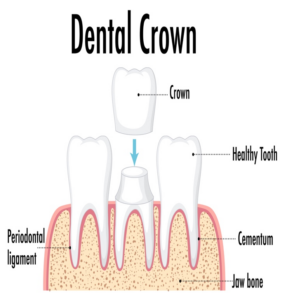
A dental crown is a custom-made restoration that covers a prepared tooth. It can help restore strength, shape, and function when a tooth is cracked, heavily filled, worn down, or weakened after treatment such as a root canal. A bridge can replace one or more missing teeth by joining an artificial tooth to crowns on nearby teeth or implants.
When a Dental Crown May Be Recommended
A crown may be suitable when a tooth needs more support than a filling can provide. That can include:
- a cracked or broken tooth
- a tooth weakened by a large filling
- a back tooth after root canal treatment
- a worn-down tooth affected by grinding or bite pressure
- a tooth with shape, contour or colour issues where a crown is a suitable restorative choice
- a tooth that will support part of a bridge
- a dental implant that needs its final visible restoration
This does not mean every worn or broken tooth needs a crown. Sometimes a more conservative option makes better sense. A bonded restoration, an onlay, a veneer, a replacement filling, monitoring, or even extraction may be the wiser path depending on how much healthy tooth is left, where the damage sits, and how heavily that tooth works when you chew.
That careful sorting-out matters. The clinic’s own service pages lean into assessment and treatment planning rather than one-size-fits-all dentistry, which is exactly how this decision should be made
What a Dental Crown Does
A dental crown does more than cover a tooth. It restores shape, protects what remains, and helps the tooth handle everyday biting forces.
A well-made crown can improve strength, function, and appearance. It also needs to fit your bite properly, sit well at the gumline, and be easy to keep clean.
At Bundall Dental and Implants, the focus is on a restoration that works well for eating, speaking, and long-term care.
Crowns, Bridges, and Missing Teeth
If the issue is a missing tooth rather than a damaged one, a dental crown bridge may be discussed. A bridge is fixed in place and usually uses the teeth on either side of a gap for support. In some cases, implants can support the bridge instead.
Bridges can help restore chewing and keep nearby teeth from drifting. They are not right for everyone. The supporting teeth need to be strong enough, and sometimes an implant or another replacement option may be the wiser choice.
Get in touch with us today to find out how we can help you achieve the smile of your dreams!
Dental Crown Procedure
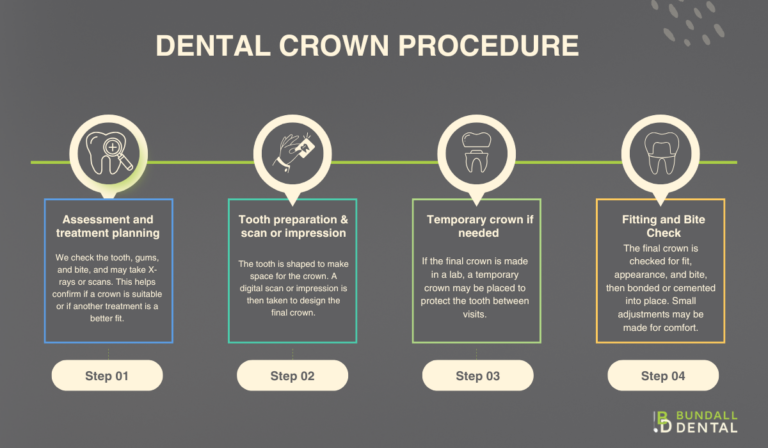
The dental crown procedure usually involves assessment, tooth preparation, a scan or impression, a temporary crown if needed, and final fitting.
In short:
- Step 1:We assess the tooth, gums, and bite
- Step 2:The tooth is prepared and scanned or recorded with an impression
- Step 3:A temporary crown may be placed between visits
- Step 4:The final crown is fitted, checked, and adjusted if needed
Suitability, Limits and Alternatives
Crowns can be a very useful treatment, though they are not a cure-all. A crown may be less suitable if the tooth is too badly damaged, decay extends too far below the gum-line, gum disease is active, or another option would preserve a healthier tooth.
Crowns also need maintenance. They can chip, loosen, crack, wear down, or develop decay around the edges. Gums around the crown can also become irritated if cleaning is difficult or the fit is not right.
Depending on the case, alternatives may include:
- a filling
- an onlay
- a veneer
- a bridge
- an implant-supported crown
- extraction and replacement
- monitoring where safe to do so
That is why treatment planning matters. Quick fixes are tempting. Good dentistry is usually a bit more thoughtful than that.
How Long Do Dental Crowns Last
There is no fixed lifespan for a crown. Its longevity depends on the material, the health of the tooth underneath, your bite, your oral hygiene, and habits such as grinding or clenching.
With good care, crowns can last for many years. They may still need repair or replacement over time. Teeth.org.au makes this point clearly: a crown or bridge does not mean the tooth will never need treatment again.
Looking After a Crown or Bridge
Other Services Under One Roof
We take pride in offering a complete suite of dental services. From preventative care to complex dental surgeries, we focus on providing patients with the care they need for a healthier smile.
Which is right for me? Your dentist will assess enamel thickness, bite and budget before recommending one or both options.
PATIENT TESTIMONIALS
What Our Patients Are Saying
Read what the people of Benowa have to say.
Frequently Asked Questions
With good oral hygiene, porcelain veneers often last a decade or more; composite averages five to seven years.
Local anaesthetic keeps you comfortable. Most patients compare the sensation to having a small filling.
Mild sensitivity to hot and cold can occur for a few days. It usually subsides as the tooth adjusts.
Porcelain won’t whiten once made, so we often whiten natural teeth before matching veneer shade.
Dental Veneers | Best Dental Veneers Gold Coast | Porcelain Veneers Gold Coast | Gold Veneers | Composite Veneers Gold Coast | Best Veneers Gold Coast | Veneers Gold Coast | Composite Veneers Gold Coast | Teeth Veneers Gold Coast