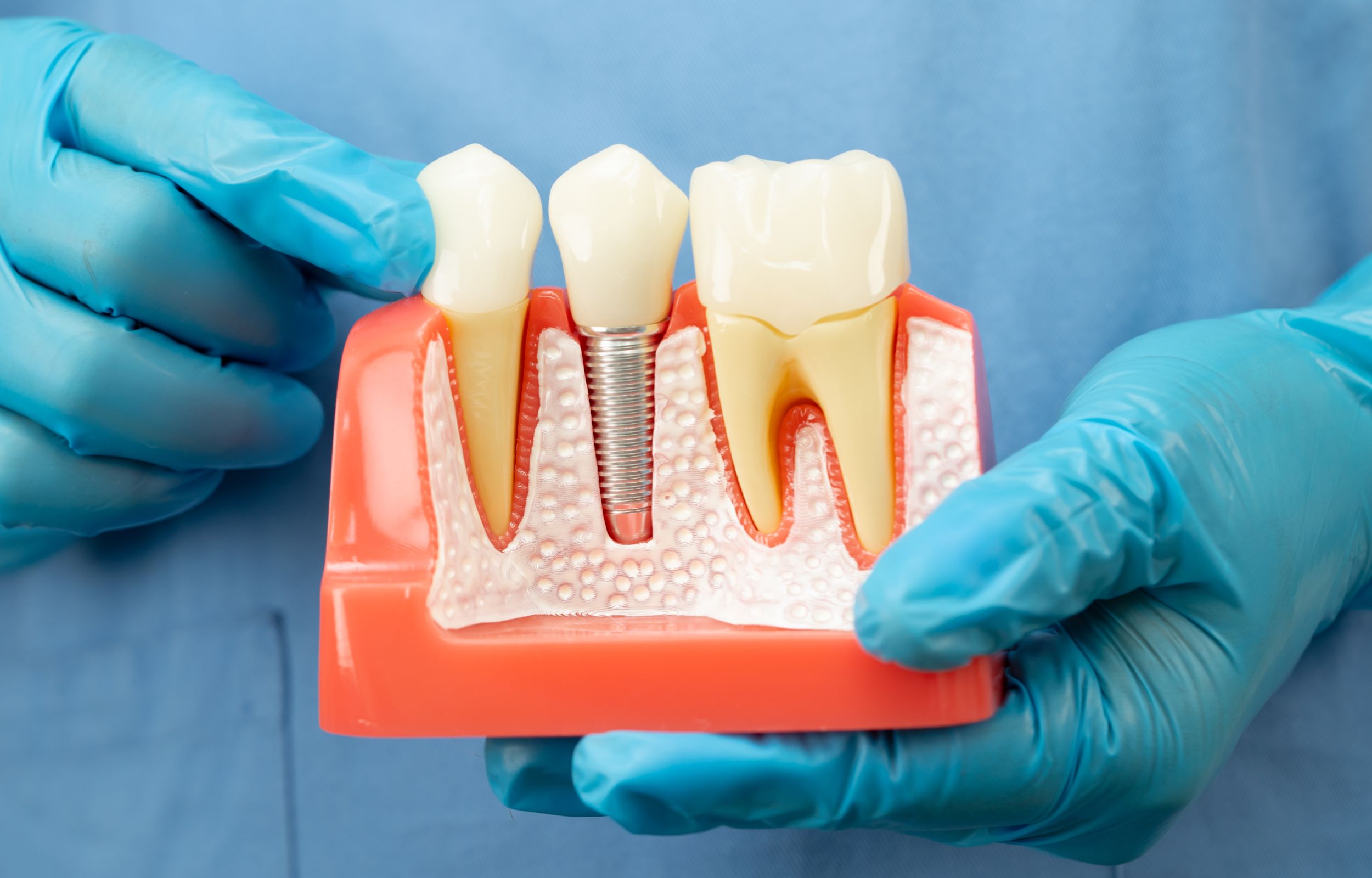
All-on-X describes full-arch dental implant treatment, where a complete row of replacement teeth is fixed onto a set of implants rather than one implant per tooth. The number can range from four up to ten, most commonly four to six, depending on jawbone volume, bite force and anatomy. A dentist determines the right configuration after a full assessment.
What Is All-on-X and How Does It Work?
All-on-X is an umbrella term, not a single fixed treatment. Here is a quick overview:
- What it is: a fixed, full-arch replacement of an upper or lower row of teeth, supported by a set of implants placed at planned angles and positions in the jawbone.
- Where it’s used: for patients missing most or all of the teeth in one arch, including those currently wearing a full denture.
- Why it’s chosen: it replaces a full arch without needing one implant per tooth, and may help preserve jawbone volume compared with a denture.
- One limitation to know: the number and position of implants is individual. What suits one patient’s jaw may not suit another.
How Many Implants Do You Actually Need?
There is no single number that suits every patient. All-on-X covers a range of configurations, most commonly four, five or six implants in one arch. The right number depends on how much healthy jawbone is available, the bite forces involved, and whether any remaining teeth need to be removed first. A dentist assesses this using a clinical examination and 3D imaging such as a cone beam CT scan, which shows bone density and volume in detail before any treatment plan is confirmed.
When Might All-on-4 Be Suitable?
All-on-4 uses four implants angled to make use of the strongest areas of the jawbone, often planned to avoid additional bone grafting. It can suit patients with reasonably good bone volume who are replacing a full arch of failing or missing teeth. Because fewer implants are placed, the surgical appointment itself may be shorter.
Does All-on-4 mean fewer visits overall? Not necessarily. While placing four implants may take less time than six, the overall treatment, including assessment, healing and fitting the final teeth, still generally spans several months.
When Might All-on-6 Be Recommended?
All-on-6 spreads the bite load across six implants, which may suit patients with reduced bone density, a heavier bite, or a history of teeth grinding. The additional implants can offer more support across the arch, though this depends on individual anatomy and is confirmed through imaging rather than assumed in advance.
Is All-on-6 always the stronger option? Not automatically. More implants do not suit every patient, and additional implants are not usually recommended unless they are needed. The decision is based on what the jawbone can support and what the bite requires.
When Might All-on-8 Be Considered?
All-on-8 adds further implants across the arch, which may be considered for patients with a larger jaw, a heavier bite, or a preference for extra redundancy in case one implant ever needs attention later. It is a less common configuration than All-on-4 or All-on-6, and is generally only recommended where the additional implants offer a clear clinical benefit over a lower number.
Does All-on-8 always mean eight implants in one arch? Usually, though the term is sometimes used loosely. Occasionally it describes four implants in the upper arch plus four in the lower for patients needing both arches treated. It is worth confirming which meaning applies to your treatment plan.
Is All-on-10 a Realistic Option?
All-on-10 sits at the upper end of implant numbers for a single arch and is uncommon in general practice. At this point, treatment can start to resemble several implant-supported bridge sections rather than the minimal-implant approach behind All-on-4 or All-on-6. A higher implant count is not automatically a better outcome, and the appropriate number is based on individual imaging and assessment rather than a preference for a higher figure.
Are There Other All-on-X Configurations?
Some patients are assessed for five, seven or nine implants, or an uneven mix, such as four implants in the upper arch and six in the lower, depending on how bone density differs between the jaws. These variations are why the treatment is often described using the broader term All-on-X rather than a fixed number.
What Other Situations Call for All-on-X Treatment?
All-on-X is also considered for patients currently wearing a full denture who want a fixed alternative, those with several failing teeth across an arch due to decay or gum disease, and patients who have already lost significant bone and require grafting before or alongside implant placement. Certain medical conditions, such as uncontrolled diabetes or heavy smoking, may affect candidacy and are discussed during assessment.
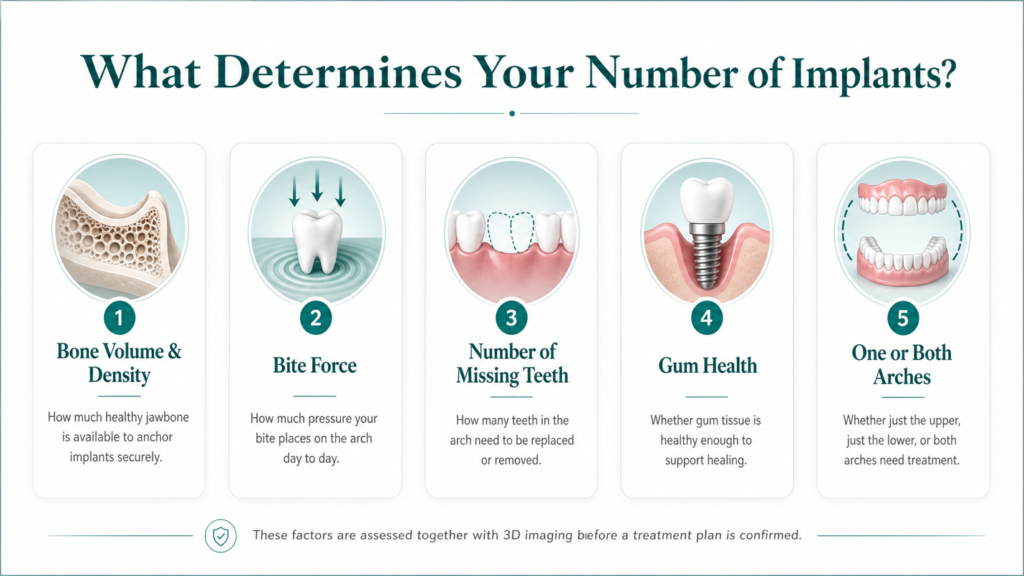
The main factors a dentist weighs up when planning an All-on-X treatment
How Do All-on-4, 6, 8 and 10 Compare at a Glance?
The table below is a general guide only. Individual suitability is confirmed through assessment, and neither option is automatically the better choice.
| Feature | All-on-4 | All-on-6 | All-on-8 | All-on-10 |
|---|---|---|---|---|
| Typical implant count | 4 | 6 | 8 | 10 |
| Common use case | Adequate bone, straightforward cases | Reduced bone density or higher bite force | Larger jaw or extra redundancy sought | Uncommon; only where clearly indicated |
| Bone grafting | Often reduced need | May still avoid it in some cases | Assessed individually | Assessed individually |
| Load distribution | Across 4 implants | Across 6 implants | Across 8 implants | Across 10 implants |
| Assessment required | 3D imaging + exam | 3D imaging + exam | 3D imaging + exam | 3D imaging + exam |
*Suitability is individual; more implants are not automatically the better choice.
How Is the Right Number of Implants Decided?
The process typically starts with a clinical examination and a 3D cone beam CT scan to measure bone volume and density in different areas of the jaw. A systematic review of full-arch implant outcomes reported survival rates above 95 per cent over several years of follow-up when cases were planned and monitored appropriately. From the imaging, a dentist maps out where implants can be placed securely and how many are needed to support a stable, fixed prosthesis. Some patients may be suitable for a temporary fixed set of teeth on the day of surgery, with a final restoration fitted once healing is complete; suitability varies and is confirmed at consultation.
Who Is a Suitable Candidate for All-on-X Treatment?
Most adults missing most or all of the teeth in an arch can be assessed for full arch and multiple teeth implant options, though suitability depends on bone volume, gum health and general medical history. Patients with significant bone loss may still be candidates following a bone grafting assessment. For a closer look at how the two most common configurations differ, see our guide on All-on-4 compared with other All-on-X configurations.
All-on-X is a general term for full-arch implant treatment. The right number of implants, commonly four to six and occasionally as many as eight or ten, depends on individual bone volume, bite force and oral health. A higher implant count is not automatically a better outcome. A dentist confirms the right approach after a clinical assessment and imaging.
Schedule a consultation with us to determine whether you need an implant or not.
Frequently Asked Questions about All-on-X Dental Implants
What are the pros and cons of All-on-4 dental implants?
All-on-4 can restore a full arch with fewer implants and may avoid the need for bone grafting in some patients. A potential drawback is less flexibility if an implant needs attention later, since more of the restoration relies on each implant. Suitability depends on individual bone volume and bite force, assessed by a dentist.
Is All-on-6 more expensive than All-on-4?
Cost depends on the number of implants, the materials used and the individual treatment plan, so a general comparison is not always accurate. Your dentist can provide a personalised cost estimate after an assessment, taking into account any additional procedures such as bone grafting.
Can I switch from dentures to All-on-X implants?
Many patients currently wearing a full denture are assessed for All-on-X as a fixed alternative. Suitability depends on jawbone volume, which can reduce over time in denture wearers, so an assessment including 3D imaging is needed to confirm candidacy.
Is All-on-8 or All-on-10 better than All-on-4?
Not automatically. A higher implant count does not necessarily mean a better outcome, and additional implants are not usually recommended unless they are needed. The right number depends on individual bone volume, bite force and clinical assessment, confirmed with 3D imaging.
How long does All-on-X treatment take?
Timelines vary, but treatment commonly spans several months from initial assessment to the final restoration, allowing time for healing and osseointegration. Some patients may be suitable for temporary fixed teeth on the day of surgery. Your dentist will outline an individual timeline at consultation.
Are there risks associated with All-on-X implants?
As with any surgical procedure, risks can include infection, implant failure or the need for adjustment over time. Regular check-ups and good oral hygiene support long-term success. Your dentist will discuss individual risks and how they apply to your circumstances before treatment begins.
Disclaimer: This article is for informational purposes only and does not constitute professional dental advice. Every patient’s situation is unique. Always consult a qualified dental professional before making decisions about your oral health.