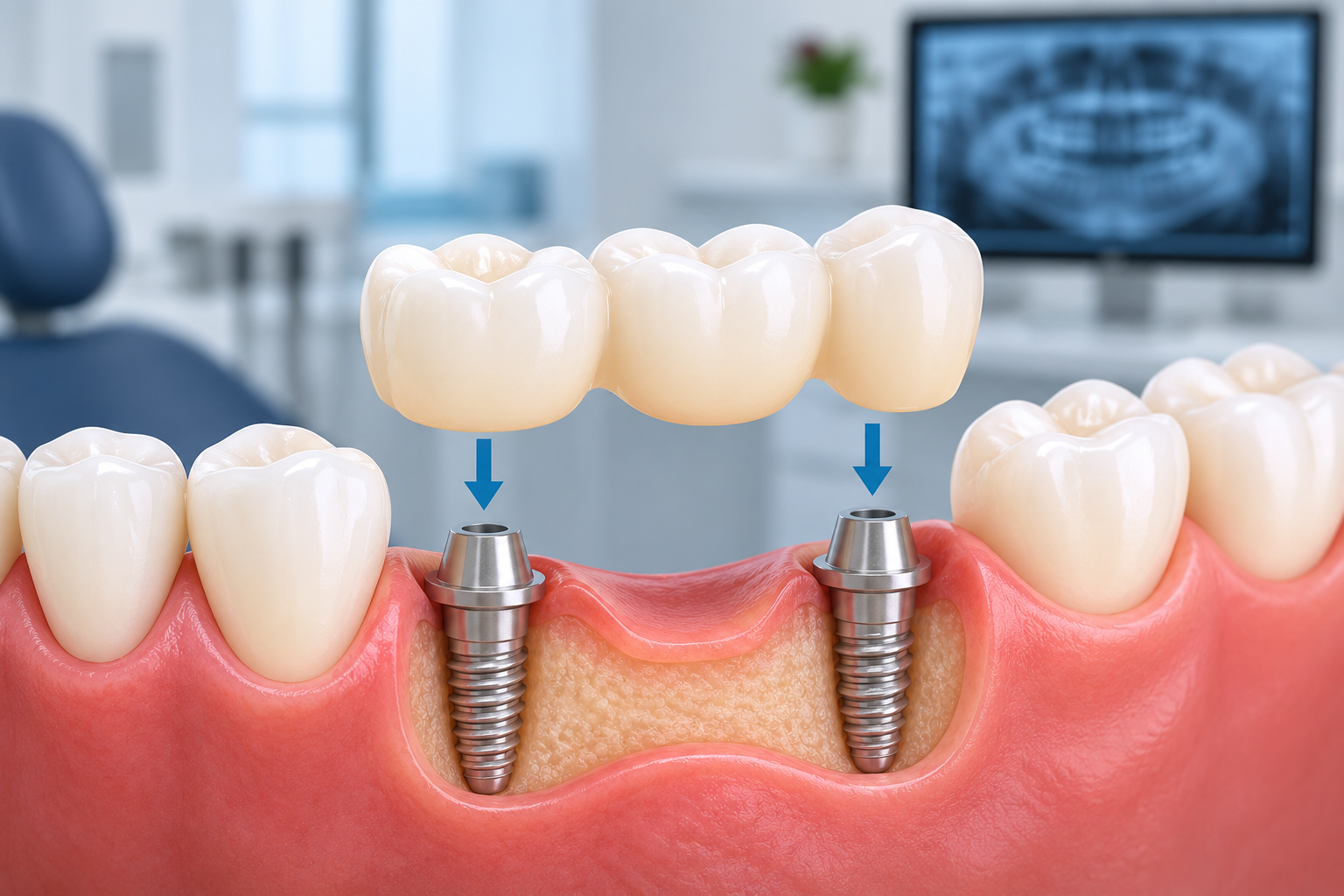
Losing a few teeth in a row, whether from decay, injury or gum disease, leaves more than one way to fill the gap. A traditional bridge anchors to the natural teeth either side of the space. An implant-supported bridge does the same job but anchors to dental implants instead, standing in for the roots that are no longer there. Which one fits depends on the span involved, the health of the neighbouring teeth, and what the jawbone underneath can support.
Quick overview
- What it is: a bridge that attaches to dental implants rather than to crowned natural teeth
- Typically suited to: three or more missing teeth in a row, where a traditional bridge would otherwise need to use healthy neighbouring teeth as anchors
- Main advantage: the teeth either side of the gap don’t need to be reshaped or crowned to carry the bridge
- Trade-off: it involves implant surgery and a healing period of several months, so it takes longer than a traditional bridge to complete.
What is an implant-supported bridge?
A dental implant is a small titanium post placed into the jawbone where a tooth root used to sit. Once it has fused with the bone, a connector and then a crown, bridge or denture can be attached on top. An implant-supported bridge uses this principle across a gap of several missing teeth: rather than one implant for every missing tooth, which Healthline notes gets expensive and often impractical for several teeth in a row, a smaller number of implants act as anchor points, with a bridge spanning the gap between them. Cleveland Clinic describes this approach as typically suited to cases where three or more teeth in a row are missing.
How is it different from a traditional dental bridge?
A traditional bridge relies on the natural teeth either side of the gap, known as abutment teeth, to carry the load. Those teeth have to be reshaped and fitted with crowns so the bridge can be cemented onto them, and that reshaping can’t be undone once it’s done. An implant-supported bridge anchors to implants instead, so the neighbouring natural teeth are left alone. Cleveland Clinic also points to two further differences: implants generally last considerably longer than a bridge on its own, and because an implant sits in the jawbone like a natural root, it helps preserve bone in that area rather than allowing it to shrink the way it typically does under a gap with no root present.
Who might need dental implants for a bridge?
This option tends to come up for adults missing three or more teeth in a row who would rather not have otherwise healthy teeth reshaped to carry a bridge. Suitability comes down to a few things a dentist checks at a consultation: enough jawbone to anchor the implants, which Healthdirect notes is assessed through X-rays and planning before surgery, and gums and general health that support healing. Cleveland Clinic lists active gum disease, significant bone loss, some autoimmune conditions and uncontrolled diabetes as factors that can make implants less suitable, and notes that smoking can also affect healing. Where there isn’t enough bone to start with, bone grafting is sometimes carried out first to build up the site.
Someone missing every tooth in an arch is usually looking at a full arch option instead, and someone missing just one tooth may only need a single implant rather than a bridge at all.
An implant-supported bridge sits specifically in the middle: several teeth in a row, not a whole arch. Bundall’s multiple teeth and full arch implants page covers how implants can support a bridge across several missing teeth, as well as full arch options.
What does the treatment process involve and how soon will it heal?
Healthdirect describes the process starting with X-rays and planning, followed by a minor surgical procedure under local anaesthetic to place each implant.
The healing phase that follows, called osseointegration, is when the jawbone fuses to the implant, and it commonly takes around three to six months depending on how an individual heals. Only once that healing is complete is the bridge itself fitted onto the implants. Mild discomfort and swelling in the days after surgery are normal and usually manageable with the pain relief your dentist recommends.
How many implants are used to anchor a given span isn’t a fixed number. It depends on the length of the gap, where in the mouth it sits, and how much bone is available, and it’s worked out individually at a consultation rather than following a single formula.
How does an implant-supported bridge compare with a traditional bridge?
| Implant-supported bridge | Traditional bridge | |
|---|---|---|
| What it anchors to | Two or more implants placed in the jawbone | Crowned natural teeth either side of the gap |
| Effect on neighbouring teeth | None; they are left untouched | Reshaped and crowned to carry the bridge |
| Suitability for longer gaps | Commonly considered for three or more missing teeth in a row | Longer spans place more load on the two anchor teeth |
| Effect on jawbone | Helps preserve bone beneath the gap | Does not prevent gradual bone loss under the gap |
| Typical timeline | Several months, including surgery and healing | A couple of visits over a few weeks |
What affects how long it lasts?
Cleveland Clinic notes that implants can last many years with proper brushing, flossing and regular dental visits, though the crown or bridge attached to them may need replacing sooner, with most crowns and bridges lasting around 15 years. Day-to-day care matters here just as much as it does for a traditional bridge: cleaning underneath and around the bridge, whether with floss threaders, interproximal brushes or whatever your dentist recommends, along with regular check-ups and cleans, is what catches small problems before they affect the implants or the bridge sitting on top of them.
The bottom line: an implant-supported bridge is one of a few ways to deal with several missing teeth in a row, and it earns its place mainly by leaving the neighbouring natural teeth untouched and helping preserve the bone underneath. It asks for more time up front than a traditional bridge, since the implants need months to properly fuse with the jawbone before the bridge goes on. Which approach actually fits comes down to the specific gap, the bone available, and what matters most to the person living with it, which is exactly what a consultation is for.
If you’re missing several teeth in a row and weighing up a bridge against implants, book a consultation with Bundall Dental and Implants. We’ll look at the gap, check the bone underneath, and talk through which option actually fits your situation.
Frequently Asked Questions
Is an implant-supported bridge better than a traditional bridge?
Not universally better, just different. An implant-supported bridge leaves neighbouring teeth untouched and helps preserve jawbone, while a traditional bridge is quicker and doesn’t involve surgery. Which one actually suits you depends on the health of the nearby teeth, the bone available, and how much time you can put into treatment.
How many implants does a bridge need?
There’s no fixed number. It depends on how many teeth are missing, where the gap sits in the mouth, and how much bone is available to anchor each implant. Your dentist works this out at a consultation rather than applying a single rule to every case.
Does getting an implant-supported bridge hurt?
The implant placement itself is done under local anaesthetic, so you shouldn’t feel pain during the procedure. Some discomfort and swelling in the days afterwards is normal and usually settles with the pain relief your dentist recommends, similar to recovering from any minor dental surgery.
How long does an implant-supported bridge last?
The implants themselves can last many years with good brushing, flossing and regular check-ups. The bridge attached to them tends to have a shorter lifespan, commonly cited at around 15 years, though this varies with how well it’s cared for and how it’s used day to day.
Can I still get an implant-supported bridge if I’ve lost bone in that area?
Possibly, depending on how much bone has been lost. Where there isn’t enough to anchor an implant safely, a bone graft can rebuild the site first. Whether that’s needed, and whether it’s worth doing, is something your dentist assesses from your X-rays at a consultation.
Disclaimer: This article is for informational purposes only and does not constitute professional medical or dental advice, diagnosis, or treatment. Every patient’s situation is unique, and treatment recommendations may vary based on individual circumstances. Always consult with a qualified dental professional before making decisions about your oral health care. If you have a dental emergency, contact your dentist or seek immediate medical attention.